
Is It Safe to Stay in Quito's Historic Center?
Yes — with standard urban awareness. Here's what safety actually looks like in Quito's UNESCO Historic Center, from someone who lives on the plaza.
Read more
%201.svg)

.svg)
.png)
The Quito School of Art — or Escuela Quiteña — is one of the Americas' most consequential artistic movements, yet one of its least known outside specialist circles. Born in the late 16th century within the cloisters of Franciscan monasteries, it emerged from an extraordinary collaboration: Spanish friars teaching European Renaissance techniques to indigenous and mestizo artists who brought their own visual traditions, sensibilities, and hands to the work. The result was neither Spanish colonial art transplanted wholesale, nor indigenous tradition unchanged. It was something entirely new — a synthesis that produced paintings and sculptures of such technical refinement and spiritual intensity that they still command attention four centuries later.
For a visitor to Quito, understanding the School is not an academic exercise. It is the key to reading the city itself.
The Quito School flourished roughly from the late 1500s through the 18th century, centered on the workshop-monastery system that trained successive generations of artists. The model began with the Colegio San Andrés, the Franciscans' teaching monastery, where indigenous and mestizo apprentices learned fresco, oil painting, and woodcarving from European masters. What made this arrangement historically remarkable — and often glossed over in older narratives — is that it was not a one-way transfer of technique from colonizer to colonized. The indigenous and mestizo artists brought sophisticated understanding of color, composition, and spiritual symbolism from pre-Columbian traditions. They synthesized Catholic iconography with indigenous visual language: indigenous faces appear in the crowds witnessing miracles; native plants frame Catholic altarpieces; the proportions and spatial relationships reflect Andean geometric sensibilities adapted to European perspective.
The Quito School's signature technical achievement was the encarnado — the technique of painting realistic, finely modeled flesh tones on polychrome wooden sculptures, creating a lifelike effect that Spanish and European visitors found both moving and unsettling. Combined with elaborate gold-leaf backgrounds and richly patterned robes, these pieces were designed to arrest the viewer's attention and create emotional intimacy with sacred figures — a tool of spiritual conversion, but executed with such artistry that the work transcended propaganda.
Several names anchor the tradition:
Miguel de Santiago (c. 1626–1706) was the School's most celebrated painter, known for his large-scale narrative cycles. His series depicting miracles and biblical scenes have a dramatic intensity and psychological depth that influenced colonial art throughout South America. His work appears in churches and collections across Quito.
Manuel Chili, called Caspicara (c. 1723–1796), was an indigenous sculptor who became a master of polychrome wood. His figures — often Christ, the Virgin, saints — are characterized by expressive faces, dramatic gestures, and the luminous encarnado technique applied with such finesse that the wood seems to breathe. Caspicara's work is the emotional core of the Quito School aesthetic.
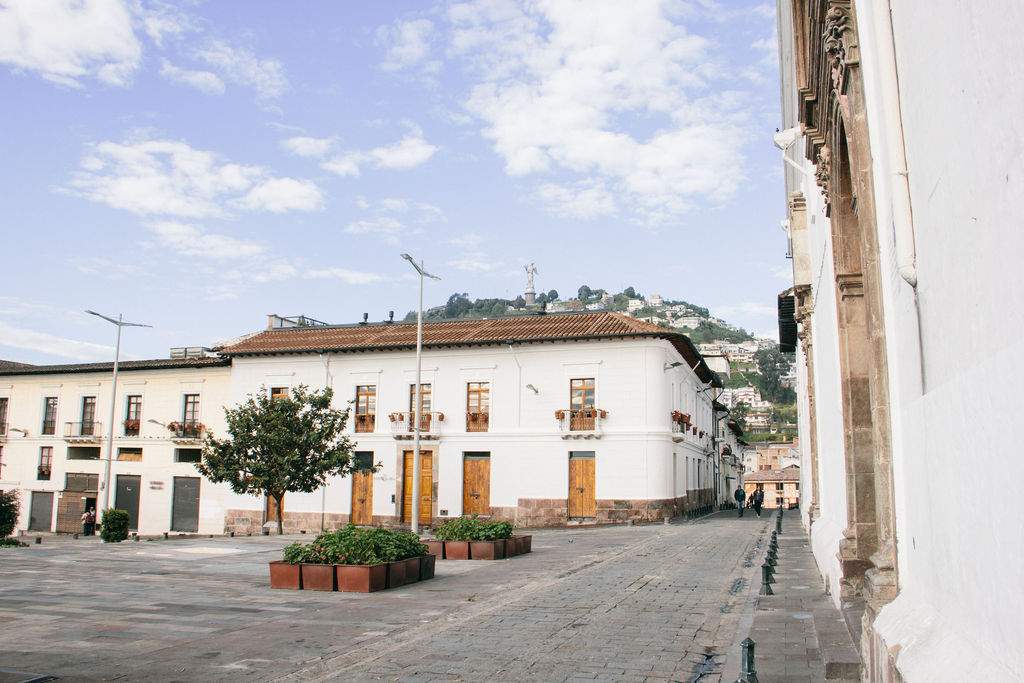
Bernardo de Legarda (died 1773) was a mestizo sculptor and innovator in the polychrome tradition. He is most famous for creating the Virgen de Quito — the winged Virgin of Quito — an image so iconic that a monumental version of it crowns El Panecillo, the hill overlooking the city. Legarda's interpretation fuses European baroque drama with indigenous geometric patterning and spiritual symbolism.
Nicolás Javier de Goríbar and other artists whose names survive in church records contributed altarpieces, statuary, and architectural ornament that filled Quito's churches and convents.
The UNESCO-designated Historic Center of Quito is an open-air archive of Quito School art. Nearly every significant church contains examples, and the particular quality of Quito is that these are still functioning spiritual spaces, not museified monuments. You are not looking at art in isolation; you are encountering it in the context for which it was created.
Iglesia y Convento de San Francisco is the oldest and largest colonial complex in Ecuador. Its gilt baroque interior, with intricate altarpieces and religious paintings, represents the full ambition of the School. The church is sensorily overwhelming — the gold leaf, the polychrome sculptures, the sheer scale of the central nave — but it rewards slow looking.
La Compañía de Jesús is arguably the richest single interior in Quito. Its facade is a masterwork of baroque stone carving; the interior is nearly completely covered in gold leaf, with paintings and sculptures at every scale. Come early in the morning when the light is best; come prepared to spend at least an hour.
Monasterio de Santa Clara, on the plaza of the same name in the heart of the Historic Center, is one of the foundational sites of the School — a working convent whose architecture and interior reflect the tradition.
Museo de Arte Colonial, located on García Moreno, houses one of the finest collections of Quito School paintings and sculptures. The museum is small, intimate, and brilliantly curated. This is the place to study technique: to see how encarnado was achieved, how gold leaf was laid, how indigenous and European iconographies were woven together.
For context on the indigenous traditions that the Quito School absorbed and transformed, Museo del Alabado (just below the Historic Center) displays pre-Columbian ceramics, textiles, and sculptures — the visual language that Quito School artists inherited and reinterpreted.
When you stand in front of a Quito School sculpture or painting, here is what to notice: the encarnado on the face and hands — the almost photographic rendering of skin, muscle, emotion. Look at the eyes; they are not blank or distant, but present and engaged. Look at the hands; they gesture with psychological specificity, not generic piety. Look at the fabrics: the robes are patterned, not plain, and the patterns often encode indigenous geometric or botanical knowledge. Look at the backgrounds and frames: gold leaf gives way to naturalistic landscape, or indigenous plants frame Catholic scenes. The syncretic details — the small acts of visual translation — are where you see the artists' agency and creativity.
Quito's Historic Center was built and rebuilt by the hands of Quito School artists and their descendants. Every street corner, every plaza, every facade tells you something about how they saw the world and what they valued. The neighborhood is not a museum village; it is a living urban quarter where families live, where markets operate, where you can buy coffee or lunch and sit in a plaza surrounded by 400-year-old architecture and art.
If you are staying in the Historic Center — as you would at Casa Santa Clara, a restored colonial residence on Plaza Santa Clara itself — you are not visiting the Quito School. You are living inside it. The Monasterio de Santa Clara is directly across the plaza. San Francisco and La Compañía are a short walk. The Museo de Arte Colonial is minutes away. You can walk the same streets the Quito School masters walked, understanding — in your bones, not just your intellect — why they chose these proportions, these materials, these ways of seeing. For travelers who want a more structured encounter with the art and architecture, the house also offers curated experiences with local art historians and guides.
The Quito School invites you not to understand colonial history from a distance, but to inhabit it, question it, and let it change how you see. Come prepared to look slowly. Come ready to sit in silence in a gold-lit church. The art will wait for you.
.svg)


%201.svg)
%201.svg)