
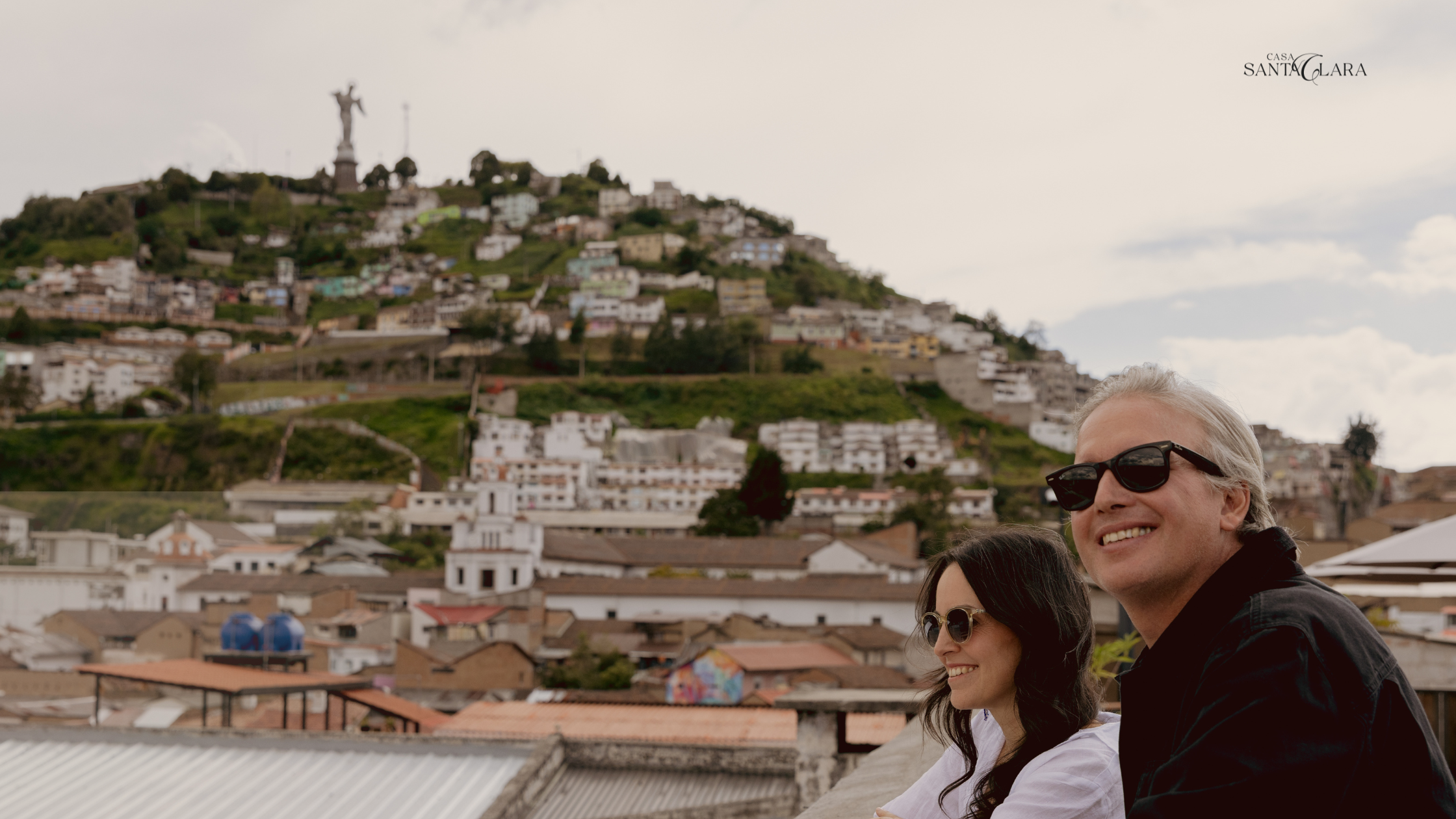
How Many Nights in Quito Before Galápagos?
Spend at least two nights in Quito before the Galápagos — three is better. Altitude adjustment, cultural immersion, and why staying in the Historic Center matters.
Read more
%201.svg)

.svg)
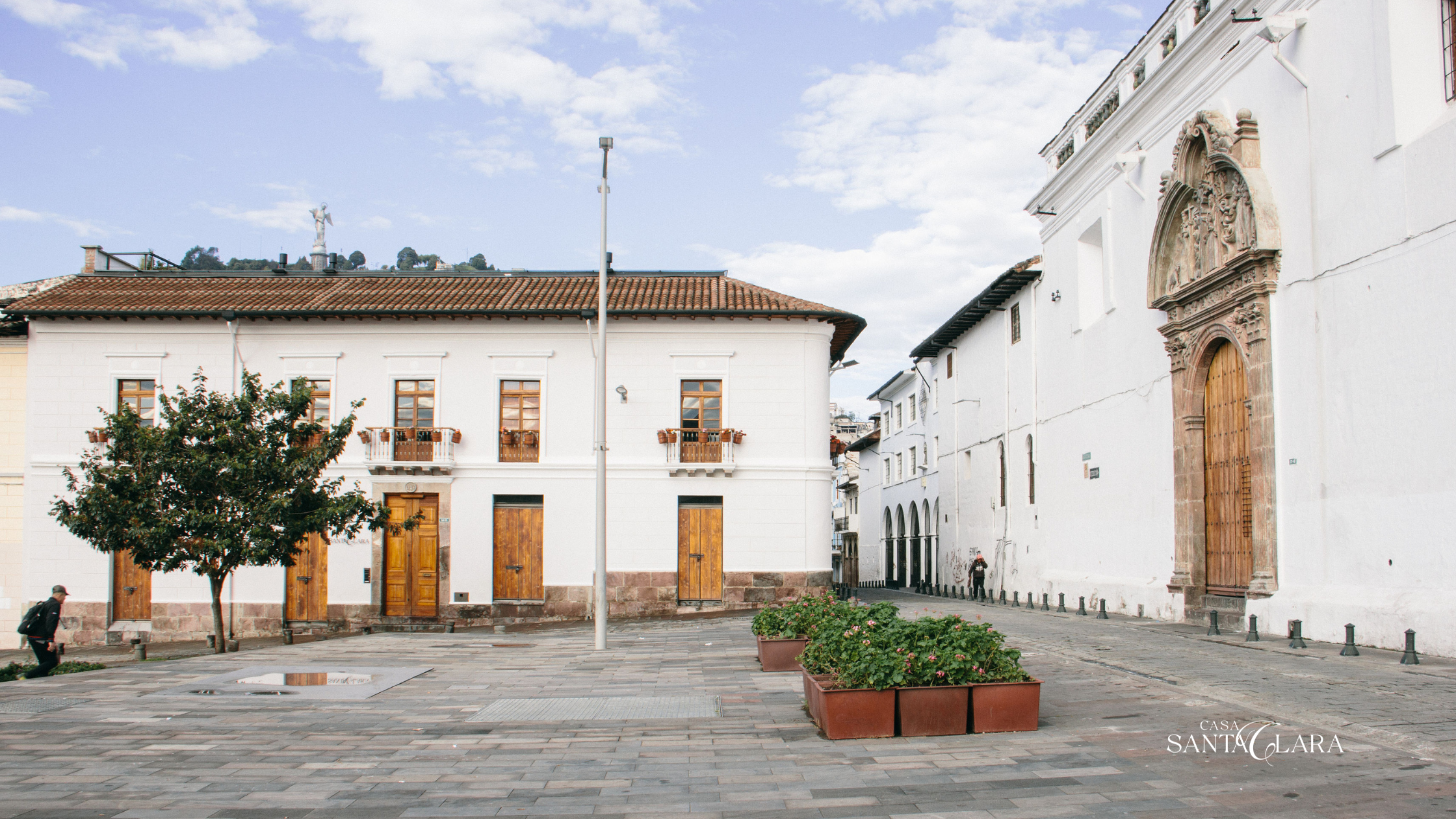
At 6:47 a.m. the bells of the Convento de Santa Clara begin — five strokes, then a pause, then five more. A woman crosses the plaza below carrying bread wrapped in a cloth. A street sweeper rests his broom against the stone bench beneath the laurel tree. From a tall window on the second floor of a restored colonial house, the morning light moves across the cobblestones in a way it has moved for roughly four hundred years.
This is Plaza Santa Clara, in Quito's Centro Histórico, and the rare thing about it is not its age. It is that nobody ever left.
Plaza Santa Clara is a small colonial square in the southwest quadrant of Quito's UNESCO-listed Historic Center, anchored by the 16th-century Convento de Santa Clara, where cloistered Poor Clare nuns still live and pray. Restored as a pedestrian plaza in 2020 after decades as a parking lot, it remains a working neighborhood square — markets, residents, bells, footsteps — not a monument.
A note for travellers researching the city: Plaza Santa Clara is not the same place as the Mercado Santa Clara in La Mariscal, which opened in 1951 and is several kilometers north. The plaza we mean here is the older, smaller, quieter one — the one that gave the convent and the surrounding parish their name.
Quito's Centro Histórico became one of the first two sites inscribed on the UNESCO World Heritage list in 1978, alongside Kraków. The reason was not a single building. It was that the entire colonial core — some 320 hectares of churches, plazas, courtyards, and houses — had been inhabited without interruption since the 16th century. Most colonial centers in the Americas survived as ruins or were heavily reconstructed. Quito's simply continued.
Plaza Santa Clara is a clear, compact illustration of that continuity. The square has cycled through uses without ever going silent:
That last layer is recent enough that some Quiteños still talk about how strange it was the first time they saw the cars gone.
The Convento de Santa Clara was founded in 1596, making it 430 years old in 2026 and the second-oldest monastery in Quito after the Convento de la Concepción (1577). It belongs to the Clarisas — the Poor Clares — a contemplative order founded by Saint Clare of Assisi in 1212. The community in Quito has lived in cloistered seclusion on this square, behind these same walls, for more than four centuries.
You hear the convent before you see it. The bells mark hours, the office, the small ceremonies of a contemplative day. Occasionally a voice rises briefly from the choir. The sisters themselves remain out of sight, and that discretion — neither performance nor mystery, just the rhythm of a working religious house — is part of what gives the plaza its particular quiet.
The cloister itself is closed to visitors, in keeping with the contemplative seclusion of the Poor Clares. However, the adjoining Chapel of Nuestra Señora del Amparo is open to the public Monday through Saturday, generally from 9:00 to 12:00 and again from 15:00 to 17:00. Mass times are posted at the door, and the chapel is a working place of worship — visit with the same restraint you would bring to any active sanctuary.
For travellers who want to understand the convent's place in the city's architectural fabric without intruding on the community, we often suggest pairing a brief, respectful chapel visit with a wider walk through the Centro Histórico. Our team has put together a few curated routes through the historic center that thread Plaza Santa Clara, San Francisco, La Compañía and the Museo del Alabado into a single unhurried afternoon.
Because Casa Santa Clara sits directly on the square, the plaza becomes a kind of slow clock for the house. A few observed moments, from the rooms that face it:
Three of our five suites look directly onto the square. The plaza-facing rooms — particularly the larger ones — were designed so that the original window proportions of the 17th-century house were preserved, which is the reason that morning light still arrives in the room the way it did when this was a private colonial residence.
When the restoration of the house was carried out, the architects worked from the premise that the building's relationship to the plaza was the most important thing to recover. Not the most expensive material, not the most photogenic feature — the relationship. The orientation. The sightlines. The hours of light. Everything that followed was placed in service of that.
It is easy to over-explain a plaza. The truer answer is that Plaza Santa Clara matters because it is one of the few places in the Americas where you can stand on a stone surface, hear a community of women praying behind a wall that was already old when the United States was founded, and watch a neighbor walk past on her way home — all in the same minute.
Plaza Grande is grander. La Ronda is more festive. El Panecillo gives you the view. But Plaza Santa Clara gives you the thing that is hardest to manufacture and easiest to lose: continuity.
Walk it at 7 a.m. and again at 6 p.m. Sit on the bench beneath the laurel. Listen for the bells. If you stay with us, do it from a window first, and then from the stones.
.svg)


%201.svg)
%201.svg)